· Release

Apple Daisy Wheel Printer and Apple Dot Matrix Printer

Apple released two products on 1 October 1982: Apple Daisy Wheel Printer and Apple Dot Matrix Printer.

It is the only dated moment the archive holds for 1982, 304 days after the previous one, 1 December 1981.

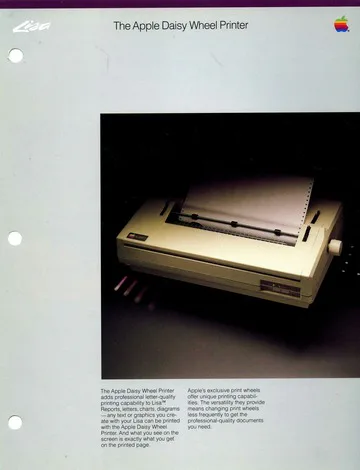
Apple Daisy Wheel Printer product photograph

Apple Computer, scanned by bitsavers · Unverified — archive.org scan of an Apple brochure

What Apple released

Apple Daisy Wheel Printer

Printers · Printers · discontinued 1 December 1983

The Apple Daisy Wheel Printer is a daisy wheel printer manufactured by Qume and sold by Apple Computer, Inc. in the 1980s. It utilized the ASCII character set and used continuous form paper, or with an optional feeder, cut sheet paper. The printer included several different 130-character "daisy" print wheels (e.g., Courier, Prestige Elite, Gothic, Executive) in English, French, German, and other languages. These 130-character print wheels are unique to the Apple DWP; the standard Qume printwheel has 96 characters.

It could be used with the Lisa system, Apple III system, and Apple IIe or Apple II Plus system if the Super Serial Interface Card was installed.

Read the full record →
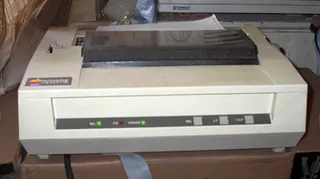
Apple Dot Matrix Printer

Printers · Printers · discontinued 1 December 1983

The Apple Dot Matrix Printer (often shortened to Apple DMP) is a printer that was manufactured by C. Itoh and sold under the Apple Computer, Inc. label in 1982 for the Apple II series, Lisa, and the Apple III. It was succeeded by the ImageWriter in 1984.

The Apple DMP is the last parallel port printer sold under the Apple label; all subsequent Apple printers (ImageWriter, ImageWriter II, Scribe, LaserWriter, etc.) were serial port printers.

Sources

  1. Apple Daisy Wheel Printer · Wikipedia
  2. Apple Dot Matrix Printer · Wikipedia

Dates are first days on sale unless a product page says otherwise; where an earlier announcement date is known, the product page gives both. Product summaries are drawn from the linked articles, and specification claims in them are the publisher’s, not independent testing. Photograph credits and licences are listed in full on the image credits page.