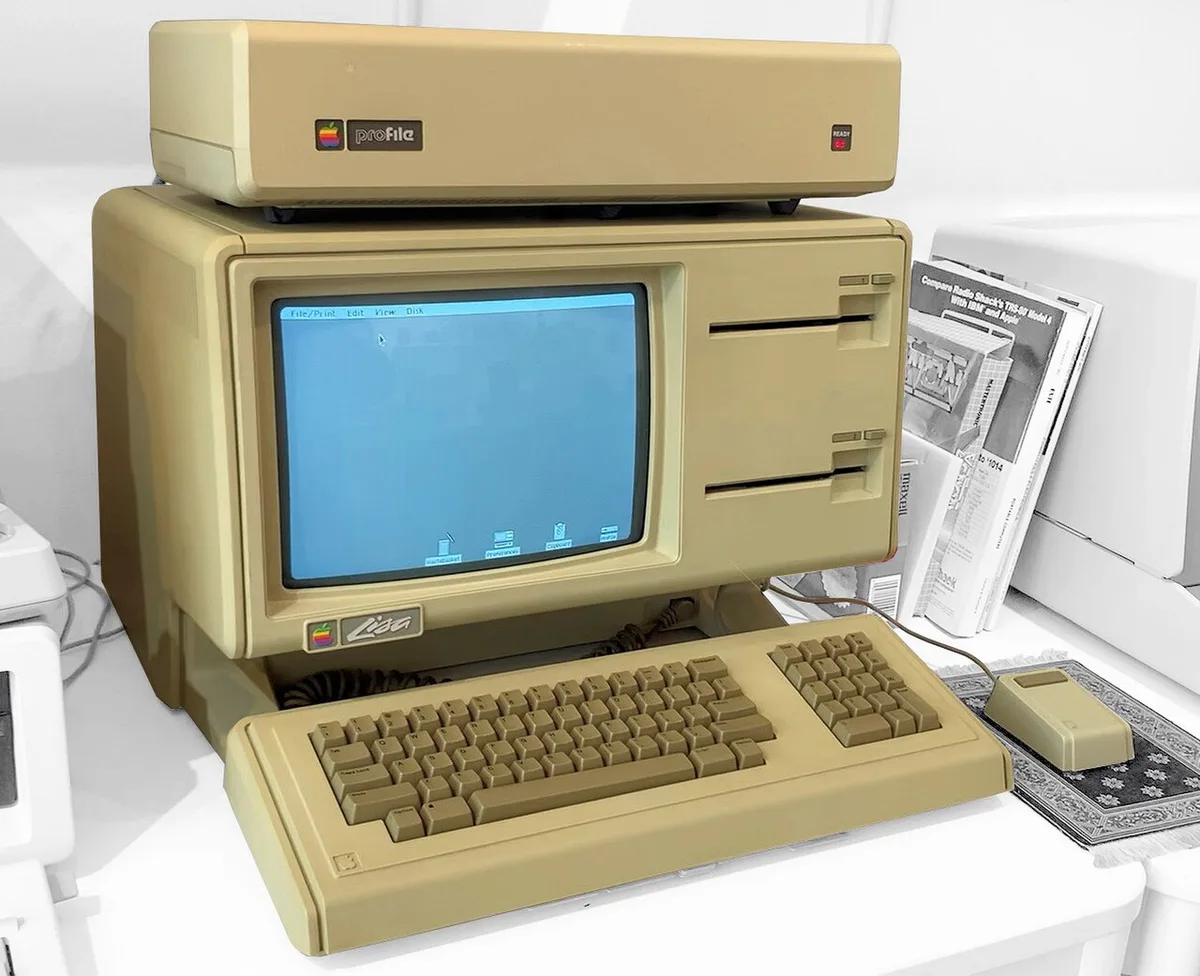
Lisa is a line of desktop computers that were designed, manufactured and sold by Apple Computer. It was the first mass-market computer operable through a graphical user interface (GUI). The Lisa was primarily marketed to individual and small and medium-sized businesses as a groundbreaking and simpler new alternative to much bigger, more complex and more expensive mainframes or minicomputers, such as those from IBM.
Development of the Lisa began in 1978; Apple co-founder Steve Jobs received demonstrations of GUI technology being developed by Xerox's Palo Alto Research Center (PARC), some of which would inspire aspects of the computer's operating system. The Lisa was based on the Motorola 68000 microprocessor, and utilized an operating system with a window-and-mouse-driven interface, a document-oriented workflow, memory protection, and a pre-loaded office suite.
Apple officially unveiled the Lisa on January 19, 1983, with a base price of US$9,995 (equivalent to $32,300 in 2025) for a model equipped with a five-megabyte hard drive. While receiving critical acclaim for its technical innovations (especially in comparison to the IBM Personal Computer), the Lisa faced criticism for its lack of third-party software, unreliable FileWare ("Twiggy") floppy disks, and its high, workstation-level price. The Lisa's CPU and storage performance were hampered by cost-cutting measures and the complexity of its software, including its use of an ad hoc protected memory implementation rather than using a hardware memory management unit.
In 1981, after Jobs was forced out of the Lisa project by Apple's board of directors, he appropriated the Macintosh project from Jef Raskin, who had conceived it in 1979 as a sub-$1,000 (equivalent to $4,400 in 2025) text-based appliance computer. Jobs gradually retooled the Macintosh into a graphical computer similar to the Lisa (sharing its Motorola 68K processor), but at a lower price point, and with a more intuitive user interface. The imminent unveiling and release of the Macintosh cannibalized interest in the Lisa, even though it had superior hardware (including hard disk drive support, up to 2 megabytes (MB) of RAM expansion slots, and a larger, higher-resolution display).
Newer Lisa models addressed the shortcomings of the original, while Apple later released MacWorks—a program that allowed the Lisa to run the Macintosh system software (and in turn, Macintosh software). Even with a major price reduction, the Lisa platform failed to achieve sales volumes comparable to the much less expensive Macintosh, with estimated units sold during its two years of availability ranging from 10,000 to 60,000. The final revision of the Lisa would be reissued as a stopgap high-end Mac known as the Macintosh XL, which shipped with a 3.5" floppy drive and MacWorks.