July 1976 · Early computers

Apple I

Apple I

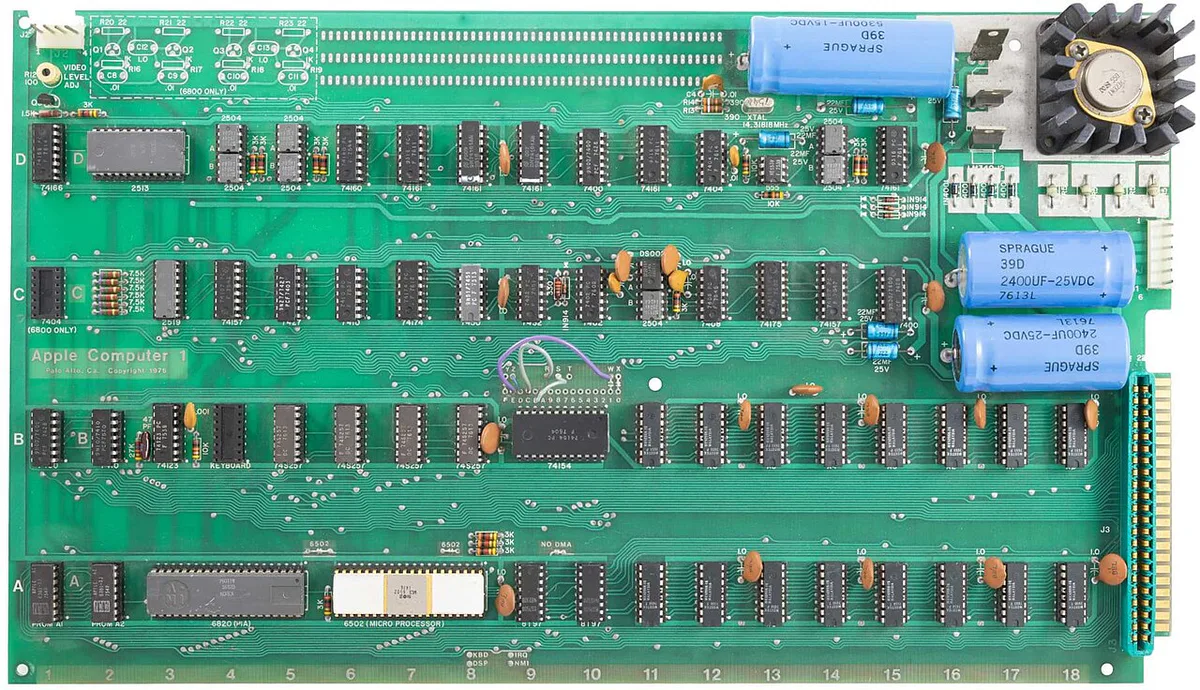
Apple I product photograph

Achim Baqué · CC BY-SA 4.0

Why it mattered

The Apple I was barely a product: buyers got an assembled circuit board and had to add a case, keyboard, power transformer and display themselves. Its importance is that it turned a hobby project into a business. The Byte Shop in Mountain View ordered 50 units, which financed Apple's first production run and proved there were customers beyond the Homebrew Computer Club. Wozniak's design also used a video terminal on the board, so it could drive a TV directly, unusual for kits of its time.

Models and prices

Model / configReleasedKey specsUS launch priceIn 2025 dollars (estimate)
Apple IJul 1976MOS 6502 @ ~1 MHz, 4 KB RAM standard$666.66≈ $3,770

Inflation-adjusted prices are estimates: launch price × (US CPI-U 2025 annual average 321.943 ÷ CPI-U annual average of the launch year), rounded to the nearest $10. Source: U.S. Bureau of Labor Statistics, series CUUR0000SA0. US list prices only; they ignore currency, taxes and carrier subsidies.

What came before and after

Before: nothing; Apple was founded on 1 April 1976. After: the Apple II (1977), a complete computer in a plastic case with colour graphics.

Buying and collecting notes

Roughly 200 were built and only a few dozen are thought to survive. Working units have sold at auction for several hundred thousand dollars; provenance and original parts matter enormously. Beware replicas sold as originals.

Questions

How much did the Apple I cost?
$666.66 in 1976, roughly $3,770 in 2025 dollars by a US CPI estimate.
Who designed the Apple I?
Steve Wozniak designed it; Steve Jobs arranged the sales.
How many Apple I computers were made?
About 200, according to commonly cited estimates.
Did the Apple I come with a case?
No, it was sold as an assembled board; owners added their own case, keyboard and display.

Sources

Apple I was released in July 1976.

The Apple Computer 1 (Apple-1), often referred to as the Apple I(written with a Roman numeral), is an 8-bit personal computer designed by Steve Wozniak and introduced by the Apple Computer Company (now Apple Inc.) in 1976. It was the company's first product and laid the foundation for what would become one of the world's largest technology companies. The idea of founding the company and marketing the computer came from Wozniak's friend and Apple co-founder Steve Jobs.

Unlike most contemporary hobbyist computers, which were sold as kits requiring assembly, the Apple-1 was delivered as a pre-assembled motherboard with built-in video display terminal circuitry. This allowed it to connect directly to a household television using a composite video cable, eliminating the need for an expensive external terminal. Users still had to supply a case, power supply, and keyboard. Powered by the MOS Technology 6502 microprocessor, it was among the earliest personal computers to offer these capabilities, alongside the Sol-20.

After demonstrating a prototype at the Homebrew Computer Club, Jobs secured an order for 50 computers from the Byte Shop, enabling production of the Apple-1. It was discontinued on September 30, 1977, following the introduction of the Apple II. Because relatively few Apple-1 computers were produced and its status as Apple's first product, surviving Apple I units are now displayed in computer museums and demand high prices at auction.

All of the 1970s →Every Early computers entry →