10 June 1977 · Early computers

Apple II

Apple II

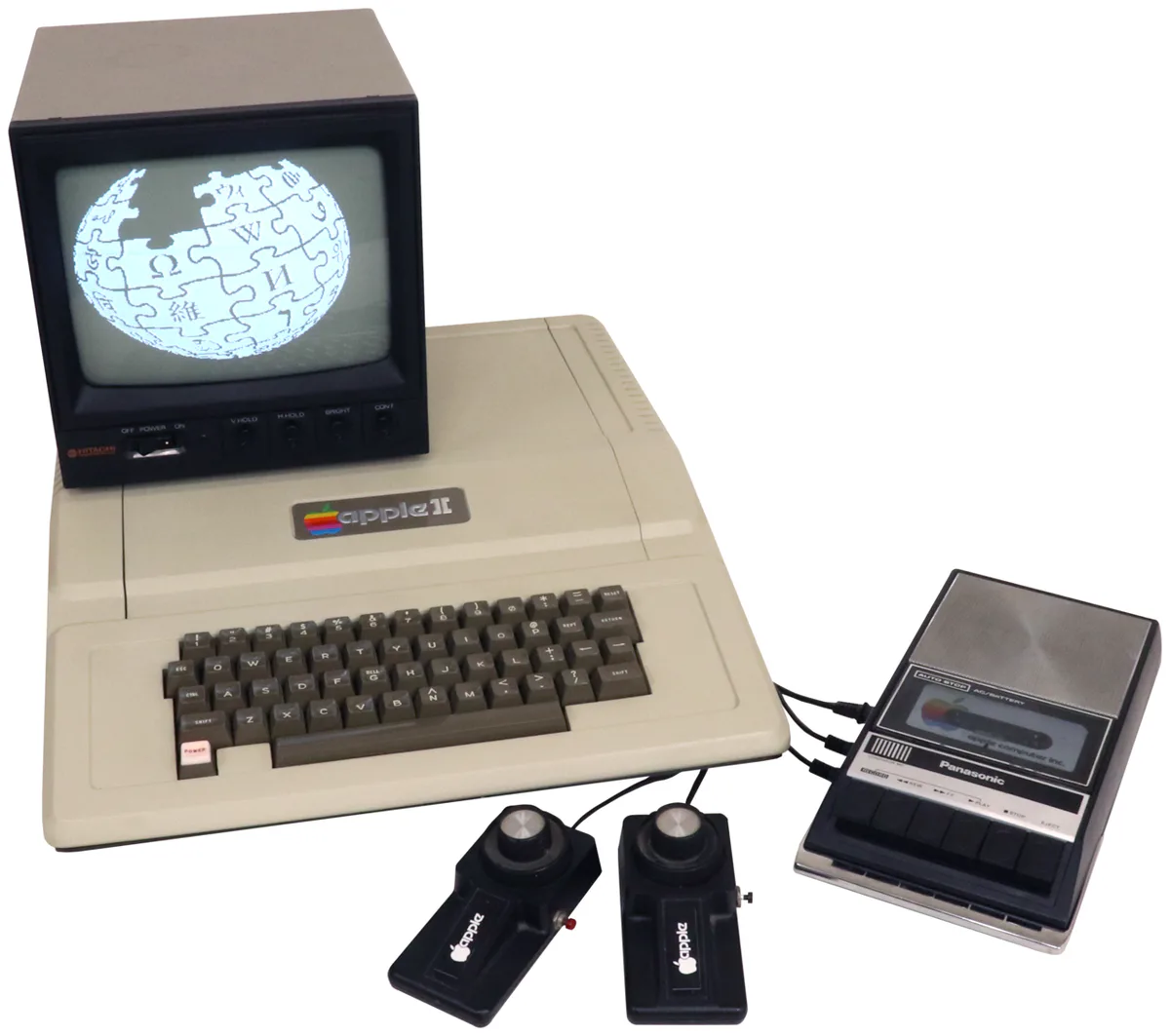
Apple II product photograph

FozzTexx · CC BY-SA 4.0

Why it mattered

The Apple II was the machine that paid for everything that followed. Unlike the Apple I it came in a moulded case with a keyboard, could display colour graphics and had eight expansion slots, which let a third-party ecosystem grow around it. The 1979 spreadsheet VisiCalc ran first on the Apple II and gave businesses a reason to buy one. The II family (II, II Plus, IIe, IIc, IIGS) stayed on sale until 1993, outliving the Apple III and Lisa.

Models and prices

Model / configReleasedKey specsUS launch priceIn 2025 dollars (estimate)
Apple II (4 KB)Jun 1977MOS 6502 @ ~1 MHz, 4 KB RAM$1,298≈ $6,900
Apple II (48 KB)Jun 197748 KB RAM$2,638≈ $14,010

Inflation-adjusted prices are estimates: launch price × (US CPI-U 2025 annual average 321.943 ÷ CPI-U annual average of the launch year), rounded to the nearest $10. Source: U.S. Bureau of Labor Statistics, series CUUR0000SA0. US list prices only; they ignore currency, taxes and carrier subsidies.

What came before and after

Before: Apple I (1976). After: Apple II Plus (1979), Apple III (1980), Apple IIe (1983).

Buying and collecting notes

Original 1977 Apple IIs with early serial numbers command a premium; IIe and IIc units are common and affordable. Check the power supply, RIFA capacitors are a known failure point.

Questions

When was the Apple II released?
It shipped in June 1977 after being shown at the West Coast Computer Faire in April 1977.
How much did the Apple II cost?
$1,298 with 4 KB of RAM and $2,638 with 48 KB.
When was the Apple II discontinued?
The last member of the family, the IIe, was discontinued in 1993.
Why was the Apple II so successful?
Colour graphics, expansion slots and software like VisiCalc made it useful for homes, schools and businesses.

Sources

Apple II was released on 10 June 1977.

The Apple II (stylized as apple ][) is a personal computer released by Apple Inc. in June 1977. It was one of the first successful mass-produced microcomputer products and is widely regarded as one of the most important personal computers of all time due to its role in popularizing home computing and influencing later software development.

The Apple II was designed primarily by Steve Wozniak. The system is based around the 8-bit MOS Technology 6502 microprocessor. Jerry Manock designed the foam-molded plastic case, Rod Holt developed the switching power supply, while Steve Jobs was not involved in the design of the computer. It was introduced by Jobs and Wozniak at the 1977 West Coast Computer Faire, and marks Apple's first launch of a computer aimed at a consumer market—branded toward American households rather than businessmen or computer hobbyists.

Byte magazine referred to the Apple II, Commodore PET 2001, and TRS-80 as the "1977 Trinity". As the Apple II had the defining feature of being able to display color graphics, the Apple logo was redesigned to have a spectrum of colors.

The Apple II was the first in a series of computers collectively referred to by the Apple II name. It was followed by the Apple II+, Apple IIe, Apple IIc, Apple IIc Plus, and the 16-bit Apple IIGS—all of which remained compatible. Production of the last available model, the Apple IIe, ceased in November 1993.

All of the 1970s →Every Early computers entry →